I recently shared on LinkedIn the need to approach social media platforms as individual communications channels and curate content targeted to that platform’s audience. I wanted to dive deeper into my thoughts on this and the case study I mentioned in that post. I realize this type of experiment may be out of reach for some because I had access to resources that a team of one may not, but I think there are things you can take away from this and perhaps create a version to meet your needs.
Organizations/businesses have fallen short in content strategy by posting the same content across all their social media channels (and using social as an informational push mechanism.) Sometimes this is because they simply do not have the staffing to curate content across an additional 4-8 channels, and it’s a lot easier just to copy and paste. Sometimes it’s because the assumption is made that your audience is the same on all social media channels.
Spray-and-pray has been out-of-date for a very long time. You have access to data from their platforms, and it will likely show you your audiences are different on each. So, how did I tackle this issue at the Federal Reserve Bank of Atlanta? Through the years, I’ve tackled this issue by using data, best practices, and my knowledge to craft strategies and hatch ideas to address this.
But here’s the thing: while social is a great way to test things, it can also present problems when you must continue to post while trying to gather the necessary data to inform a longer-term strategy. It took time, which can make people cringe. People want results now and don’t want to wait.
I was lucky because I enlisted others involved in the content review process to help execute the idea. Not everyone has that, but I hope you can glean some ideas to help you make your case.
When I first arrived, I learned the posting strategy was to simply post a tweet to Twitter and copy and paste the web description to Facebook when the content went up on the website. LinkedIn was hardly used at all, and when it was, there was no discernable strategy for what went there. That meant they were posting five or more times some days and not at all on others. The posting was inconsistent, and the copy wasn’t written to appeal to the audience on that channel. That copy had to go through the reputational and editorial review process. Still, the person overseeing social media never saw the copy until it went live. The social media person only really worked on “campaigns,” and there was no holistic strategy. You had two separate teams using the same outlets and not devising a coordinated plan. And, if you’ve worked in social media long enough, you know those algorithms don’t care who on your team is posting but what is being posted.
Internal changes were necessary to make us more efficient in the process. Our social media management tool contract was up for renewal. I used it as an opportunity to switch from Hootsuite to Sprout Social, which provided us with better functionality for a team of 15 that needed access. No, we didn’t have 15 people on our team per se, but those people were interchangeable depending on who was in the office and ensured that someone with a specific role in the review process had access.
Knowing we couldn’t just stop posting but needed to gather data, I developed a plan to launch a would-be science experiment using the newly created Digital Analytics & Strategy Hub that was the brainchild of the fantastic Jared Johnson. DASH was a custom-built dashboard that provided anyone with access to on-demand metrics across ten different external communications channels. It was an absolute game-changer for looking at the return on our resource investment and engagement. The project could incorporate up to 30 platforms in the future.
Writing the copy for most of our social media fell to our editorial team, who already worked closely with the content creators. Since they already knew about the content, this made the most sense to us. And that didn’t exclude me completely. There were still instances where I was writing the content. So, everyone, myself included, went through social media copywriting training to learn how writing for Twitter differs from writing for Facebook. That training had information on our audience-specific data for those platforms and best practices, so we could start to curate copy based on all this information.
The next step was to streamline our internal processes. Remember how things were being posted when the content went live? For the most part, that stopped, and we started using a content calendar housed in Asana to offer complete transparency to everyone about what was being posted and when. Some things, like data tools, had to continue going out when updated. But, because these were linked to already established publish dates, we accounted for them in the posting strategy. They were the first things to be loaded on the calendar. And in true Enneagram 1 fashion, that calendar was color-coded by the department, and each task was tied back to the larger project already existing for that content.
One of the most significant changes was that these editors provided platform-specific posts for Facebook, LinkedIn, and Twitter instead of just writing a tweet. Since we didn’t have a consistent baseline, the data would prove invaluable later when I proposed only posting certain content on specific platforms. In the case of Twitter, I asked for two tweets — one to post during business hours and one to post outside of business hours. Ideally, I didn’t want to continue to post everything everywhere, but I knew we needed to. Even if we had just stopped there, I knew we would see a bump. Why? Because we were not only writing for the platforms and using the data within those platforms to identify critical data points to inform when to post on those platforms.

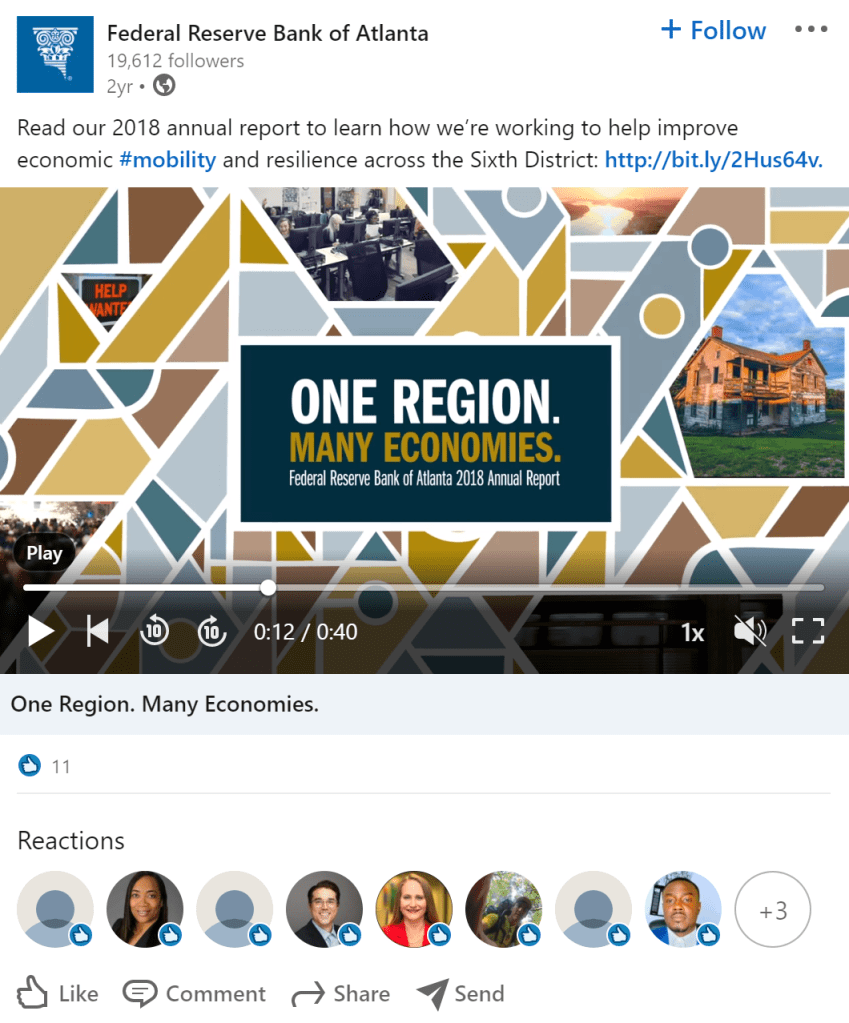
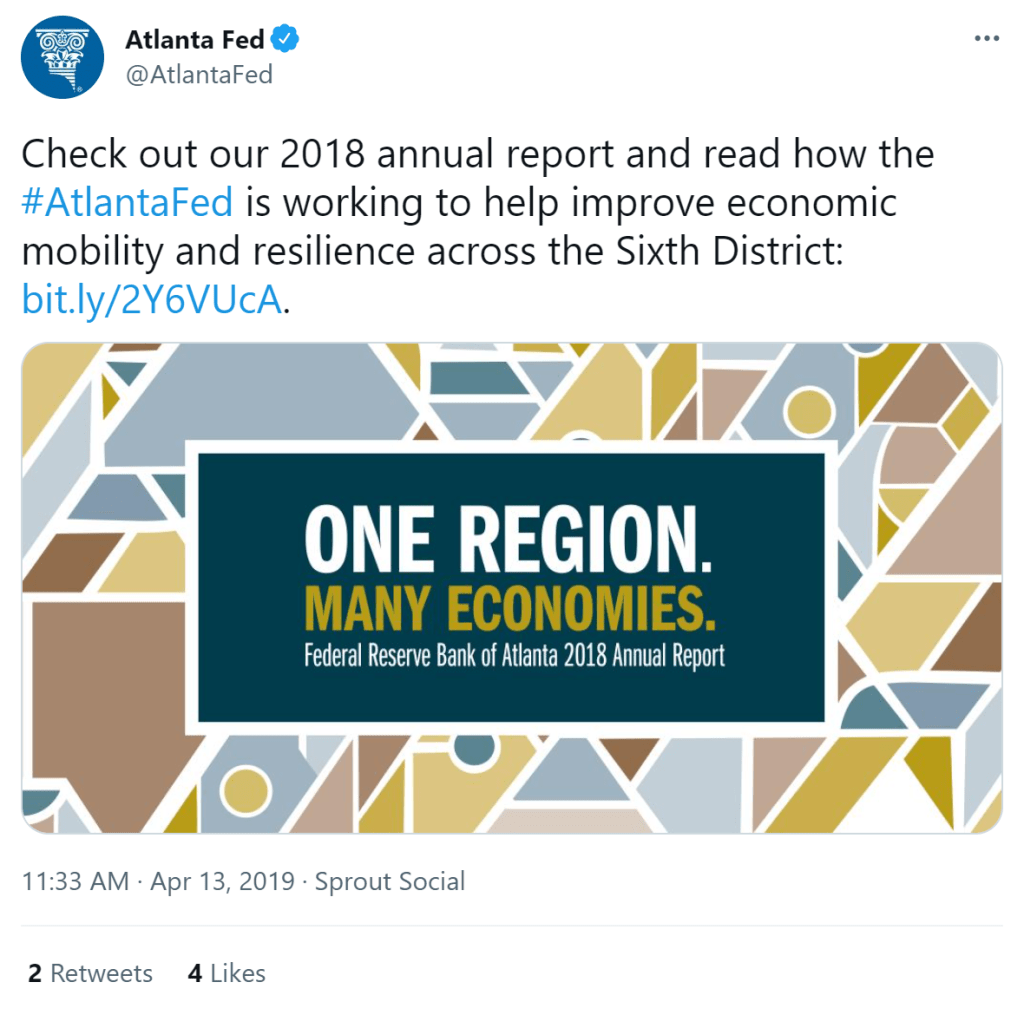
Posts for the 2018 Federal Reserve Bank of Atlanta annual report – Facebook, LinkedIn, and Twitter.
Using Sprout Social, we set up a new internal process workflow so our team could more efficiently review everything (bye, bye email). Because we were reviewing tons of content daily, most of us opted to cut off email notifications from Sprout since we were in there all the time. This process also allowed us to have a digital review timestamp because if we were ever audited (which was possible), we could show the process and who signed off on each step. We also got our creative team involved because they created amazing graphics to accompany the content on the website, so why not use it on social media? They started creating those graphics as part of their team’s process and were already providing those to our editors, so they just added the new ones to what they were already doing.
When the editor had everything they needed, they loaded that content to Sprout and chose someone on the social media team (i.e., mostly me) to send that to next. Before, they were hashtagging to track internally, not based on the relevant conversation around that topic (specific for Twitter, primarily). We could flip that script by using the tagging function within Sprout, a critical piece of DASH. Those tags were the way we segmented data by project. Because we had a data dictionary loaded on our data warehouse, that data was rolled up to the department, Bank division, one of the Bank’s five core functions outlined in the strategic plan, and even one of the Fed’s two congressional mandates.
The social media team would review each post to ensure the hashtags used were appropriate, the copy read well for the audience, and to schedule the content using that content calendar. If there were any issues, the social team worked with the editor to sort things out. We only had a handful of instances where the posts had to go through editorial review again. We trusted the editors because they worked closely with the creators, so it was essential to include them if we felt something didn’t read well. It was also a great learning tool for everyone involved and kept the back-and-forth two people instead of four or five. As for that predetermined content, we created a single document with the already approved copy. That meant our web team could post that information as soon it went live without the need to go through the more extensive approval process. Communication and planning were key in getting that setup.
The last step in that process was to send everything to someone higher up for reputational review. In most cases, this was a formality. This content was already going through checks along the way; if it had been flagged for reputational concerns at the onset, it wouldn’t have been produced. Once they approved, the posts were scheduled since we had already done that in a previous step.
This process also introduced efficiency in planning. Was it frustrating for some of our content creators? Sure. But, using already existing data and best practices (and having our department’s leadership support), we were able to show how these changes would result in upticks in engagement for their content. I knew the internal changes alone would result in a spike, but that wasn’t the end goal here. A longer-term strategy was at play, but we had to show we were on the right track to get there.
It seemed cumbersome, and in some ways, it was, but we found a way to work within the sandbox we had. Not everyone has to have three to four people review everything before it goes out, but we did. And there was no way around it. The biggest thing for us was giving everyone involved the proper training. Hence, they were confident in their work and streamlining our process to reduce emails, confusion, and a straightforward, trackable workflow. The result? We saw a 150-percent increase in social media engagement over those six months. But that was just the beginning.
I took that six months of data, and using DASH; I was able to show that our audiences weren’t the same on social. And in most cases, it was clear-cut differences. The DASH data and experiment results matched the hypothesis I had written down before we even started this. And I was only making a hypothesis based on the audience data available in each platform, not post-specific data. Among the results? Research did best on Twitter, community and economic development on LinkedIn, and economics education on Facebook. And, the most well-known product they produce, GDPNow, we found the one platform where it wasn’t heads above everything else – Facebook. That information alone surprised people, but it shows you can’t always assume that something getting regular mentions in The Wall Street Journal or Bloomberg means that an audience of primarily Generation X women will respond to it in the same way.
We all want our content to be seen, so start by asking if your audience likes this content. There’s a way to find out. And there’s value in tackling the more significant issue with a more long-term approach in a fast-paced, rapid-response world. Strategy is about the long-term game, not quick wins. And when you think about the bigger picture, you’ll have sustainable results.
 CASSIE CHANCE